
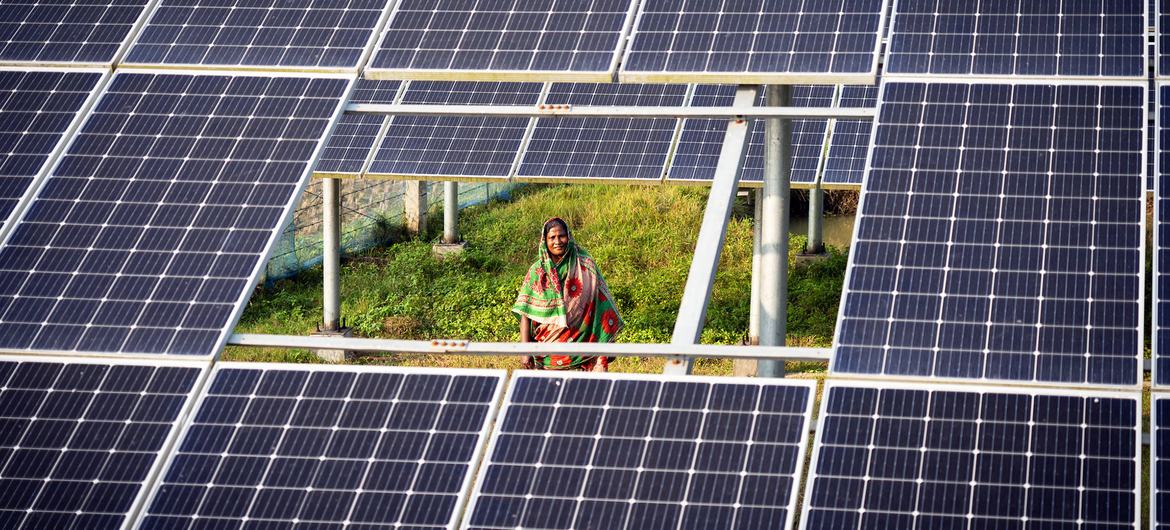
Speaking from New York, the UN Secretary-General delivered on Tuesday a scathing indictment of fossil fuels and a passionate plea for a faster and fairer transition to renewables. With the East River as a backdrop and the blue summer sky bearing witness, António Guterres sounded the end of an era—the age of coal, oil, and gas.
“Fossil fuels are running on borrowed time,” declared the United Nations Secretary-General at the start of a landmark speech, one of the most powerful of his tenure. “We are on the brink of the clean energy age.” Supporting this assertion, a new report—produced in collaboration with several international institutions—delivers a clear verdict: the transition to clean energy is not only well underway, it has become irreversible.
Backed by solid figures, the report shows a dramatic drop in the cost of solar and wind energy. “Solar power, which not long ago cost four times as much as fossil fuels, is now 41% cheaper. Offshore wind is 53% cheaper,” Guterres noted during a high-profile press conference held at UN Headquarters.
An Irreversible Economic Turning Point
In 2024, more than 92% of newly installed electricity capacity worldwide came from renewable sources—beating fossil fuels for the first time in modern history.
Faster to build, more competitive, and less vulnerable to geopolitical shocks, clean energy now represents the rational economic path. “Countries clinging to fossil fuels aren’t protecting their economies—they are sabotaging them,” said the UN chief, criticizing subsidies that continue to favor polluting fuels over sustainable competitiveness. “They are driving up costs. They are slowing their own competitiveness. They are locking themselves into stranded assets. And they’re missing out on the greatest economic promise of the 21st century.”
In 2023, global investments in clean energy surpassed $2 trillion—$800 billion more than those in fossil fuels. The clean energy sector now employs more than 35 million people—more than the fossil fuel sector.
Far from being a utopian dream, the transition is already underway: the clean energy sector now accounts for 10% of global growth, 20% in China, and one-third in the European Union. Even Texas, the historic stronghold of American oil, has become the leading producer of renewable energy in the United States.
Energy Security, Reinvented
“Let’s be clear: fossil fuels are now the greatest threat to energy security,” Guterres stated forcefully. He recalled the spike in gas and oil prices following Russia’s invasion of Ukraine, the soaring electricity bills, and the geopolitical tensions destabilizing economies.
In contrast, Guterres stressed, “Sunlight does not spike in price. Wind cannot be embargoed.” Everywhere, renewables can offer real energy sovereignty to nations, and greater autonomy to citizens.
This promise is especially vital for Africa, a continent rich in solar resources, where 600 million people still lack access to electricity. Africa’s solar potential alone could generate ten times its projected energy needs by 2040.
Too Late to Turn Back
According to the Secretary-General, three forces now make the transition inevitable: market logic, the pursuit of security, and the growing accessibility of clean technologies.
Clean energy can be deployed more easily and at lower cost than fossil fuels. “You can’t build a coal-fired power plant in someone’s backyard—but you can install solar panels in the most remote village on Earth,” he said, citing the example of microgrids already transforming rural communities. “Nothing can stop the energy transition. But it is still neither fast enough nor fair enough,” he warned.
Stark Inequalities
The report unveiled Tuesday highlights the glaring inequalities in investment distribution. Africa, home to 60% of the world’s solar potential, attracted less than 2% of global clean energy investments in 2024. Since 2016, less than one in five clean energy dollars has gone to developing countries—excluding China.
To address this, Guterres called for urgent reform of the global financial architecture: expanding lending capacity of multilateral development banks, converting debt into climate investments, and lowering the cost of capital for countries in the Global South. “Developing countries are paying outrageous sums to access finance […] partly due to outdated risk models, bias, and flawed assumptions,” he denounced.
A Call to Action
In a speech blending technical recommendations and political urgency, the Secretary-General called on governments to align public policies, end fossil fuel subsidies, massively invest in grids and storage, make supply chains fairer, and unlock finance for the Global South.
He also urged the tech giants to act: “Today, I call on all major tech companies to ensure that all their data centers run on renewable energy by 2030. […] The future is being built in the cloud. It must be powered by the sun, the wind, and the promise of a better world.”
Less than four months before the next UN Climate Conference, COP30, which will be held in Brazil, António Guterres raised the stakes. “The fossil fuel era is on its last legs,” he declared. “We are at the dawn of a new energy age.”
In other words: the energy future will be renewable—or it won’t be.

Comments are closed, but trackbacks and pingbacks are open.