
- How Africa’s premier development financing institution is powering Nigeria’s higher education sector and transforming energy access and skills development.
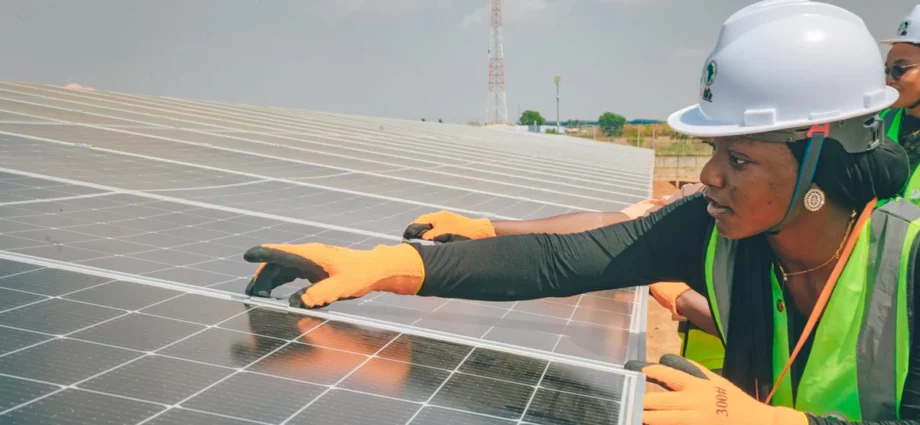
Female STEM interns inspect solar panels installed at Nigeria’s Federal University of Lafia as part of Phase III of the Energising Education Programme, financed by the African Development Bank Group.
At Nigeria’s Federal University in Lafia, in the north-central part of the country, a new solar hybrid project financed by the African Development Bank Group is making a difference in the lives of people by delivering reliable electricity to classrooms, laboratories, offices and other facilities. Power cuts that were once common are becoming a thing of the past.
The University’s Vice Chancellor, Professor Shehu Abdul Rahman, highlights the impact on the university’s operations: “We have battled high electricity expenses, with monthly bills reaching about ₦25 million ($17,000), even with unreliable supply. This intervention has allowed us to redirect resources to research and other institutional priorities, and for the past two months we have enjoyed reliable power since the project began supplying the university. Reliable electricity is essential for meaningful academic and scientific work.”

Federal University Lafia leadership, African Development Bank, Rural Electrification Agency, and Ministry of Finance representatives at the Workshop and Training Center in Nigeria’s Nasarawa State.
Complementing the solar hybrid system is a renewable energy workshop and training centre that is equipping students with practical skills. Rahmat Abdullahi, a third-year computer science student, says: “The stable electricity has allowed me to study longer hours without interruption; it has improved my academic experience. The Science Technology Engineering and Medicine (STEM) training has also helped me apply what we learn in class more practically.”
The power plant is one of eight being built by the government across eight Nigerian federal universities, with financing from the African Development Bank Group, under Phase III of the Energising Education Programme (EEP), a component of the $200 million Nigeria Electrification Project.
 In addition to the Federal University of Lafia, the beneficiaries are University of Port Harcourt and its Teaching Hospital; Federal University Dutsin-Ma; Modibbo Adama University, Yola; Federal University Lokoja; Federal University of Technology, Akure; Federal University of Technology, Owerri; and Federal University of Uyo.
The programme will deliver a combined 36.5 megawatts of solar hybrid capacity across the eight universities – enough electricity to run eight universities and one university teaching hospital around the clock, which is comparable to powering more than 30,000 Nigerian homes annually. The plants integrate photovoltaic generation, battery storage, and backup support to enhance operational resilience.
By targeting universities – critical anchors of Nigeria’s human capital development, the programme demonstrates how strategic energy investments can catalyse impact across education, healthcare, research, and workforce readiness.
Early Operational Gains in University of Port Harcourt

University of Port Harcourt leadership, African Development Bank Group, Federal Ministry of Finance, and female STEM interns about to showcase early operational progress at the Workshop and Training Center.
During a recent inspection mission to the Federal University Lafia and the University of Port Harcourt, Dr. Chigoziri Egeruoh, Project Task Manager and Power Engineer, represented the African Development Bank’s Director General for Nigeria, Dr. Abdul Kamara, and joined Dr. Oyebode Akande of the Federal Ministry of Finance and Olufemi Akinyelure, Head of the Nigeria Electrification Programme; the team confirmed strong implementation momentum, observed early impacts on the ground, and projected full operational integration as Phase III advances
At the University of Port Harcourt, the 10.77 megawatts solar hybrid installation is designed to serve both the university campus and its teaching hospital. Since the start of trial operations in December 2025, monthly electricity expenditure has declined from approximately ₦150 million ($103,000) to about ₦100 million ($69,000).
Vice Chancellor Professor Owunari Georgewill said: “Electricity supply was previously inconsistent and costly. This project has reduced our bills, improved campus security, and made the environment brighter and safer. We are committed to ensuring its long-term sustainability.”
Electricity distribution is active across the university campus, while the integration of the Teaching Hospital with the new system is progressing.
Chief Medical Director Professor Chituru Orluwene of the teaching hospital at Port Harcourt said: “Our core mandate is service, research, and training, and none can function effectively without stable electricity. We look forward to the university coming fully on board and the Teaching Hospital’s integration, so that reliable power is available across all critical operations.”

Female STEM interns inspect solar panels installed at Nigeria’s University of Port Harcourt as part of Phase III of the Energising Education Programme.
National Impact and Partnership
Phase III of the Energising Education Programme (EEP) is expected to benefit more than 180,000 students and staff, install over 5,300 smart meters, deploy more than 2,500 streetlights, and significantly reduce diesel dependence.Approximately 160 female STEM students have begun receiving dedicated hands-on technical training, strengthening Nigeria’s renewable energy workforce pipeline, while hundreds more students gain practical exposure through the Renewable Energy Workshop and Training Centres.

Solar hybrid installation at the University of Port Harcourt (left) and Federal University Lafia (right)
Phase I of the EEP was financed by the Federal Government of Nigeria, Phase II by the World Bank, and Phase III is supported by the African Development Bank Group. The programme contributes to Mission 300, the joint African Development Bank–World Bank initiative to provide electricity access to an additional 300 million people in Africa by 2030.
Source : African Development Bank Group

Comments are closed, but trackbacks and pingbacks are open.