
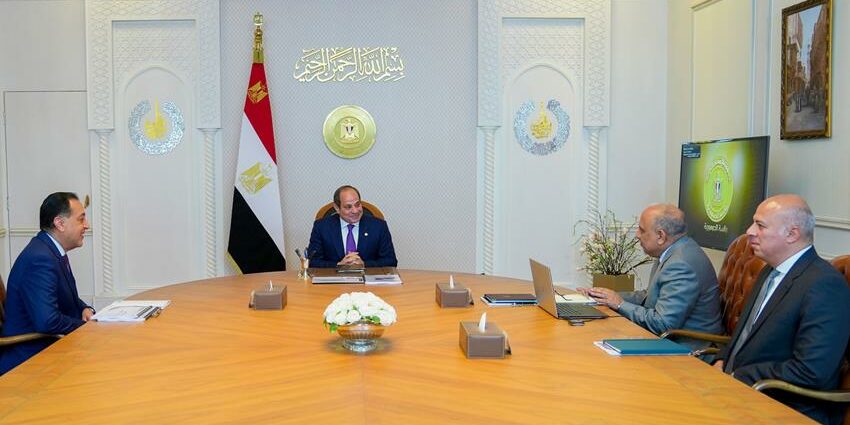
President Abdel Fattah El-Sisi met with Prime Minister Mostafa Madbouly and Minister of Electricity and Renewable Energy Mahmoud Esmat to review preparations for the upcoming summer season and to assess progress on Egypt’s renewable energy and grid modernization strategy.
According to Presidential Spokesman Ambassador Mohamed El-Shennawy, the meeting focused on ensuring the stability of electricity supply amid expected increases in consumption on the national grid. The Ministry of Electricity and Renewable Energy projects a 6% to 7% rise in demand during the summer months, driven by higher temperatures and expanding industrial and residential consumption.
3,000 MW of Solar and Expanded Battery Storage
To accommodate anticipated load growth, the government plans to add 3,000 MW of solar capacity in 2026. In parallel, Egypt will introduce 600 MW of new battery storage capacity before the summer, bringing total available battery-backed capacity on the grid to 1,100 MW.
President El-Sisi emphasized the importance of managing unprecedented consumption levels while maintaining grid stability and continuous power supply. He directed authorities to continue integrating renewable energy into the national energy mix, enforce quality standards, and ensure economically efficient operations.
Grid Modernization and Infrastructure Expansion
The President also reviewed progress in upgrading and expanding Egypt’s electricity infrastructure. Minister Mahmoud Esmat confirmed that the national grid is operating according to high-quality technical standards and remains capable of meeting the country’s growing demand.
In 2025 alone:
- 34 new transformer stations at various voltage levels were completed and connected to the unified grid.
- Expansions were carried out at 40 additional stations.
- Approximately 194,000 km of distribution lines and 5,610 km of transmission lines were installed.
These investments aim to strengthen reliability across residential, commercial, and industrial sectors while reducing technical losses and improving overall system performance.
Advancing the 42% Renewable Energy Target
The meeting also reviewed progress on renewable energy projects implemented in cooperation with leading private-sector partners. Egypt has already achieved a significant portion of its strategy to ensure that renewables account for 42% or more of total electricity generation by 2030, a target officials say is being advanced ahead of schedule.
President El-Sisi reiterated the need to continue expanding renewable capacity, reduce reliance on fossil fuels, and localize the manufacturing of electrical equipment. He stressed the importance of transferring modern technologies to support long-term energy security and industrial development.
Regional Interconnections and Energy Hub Ambitions
Electricity interconnection projects with neighboring countries were also high on the agenda. Egypt continues to position itself as a regional energy hub by strengthening cross-border grid connections.
Particular emphasis was placed on the electricity interconnection project with the Kingdom of Saudi Arabia. The first phase of the project, delivering 1,500 MW, is scheduled to become operational in time to support Egypt’s summer 2026 power supply plan. Officials highlighted its strategic importance for enhancing grid flexibility and seasonal load balancing.
Supporting Industry and Investment
President El-Sisi concluded the meeting by directing the government to prioritize energy availability for both productive and service sectors. Ensuring uninterrupted industrial operations, attracting new investments, and meeting citizens’ consumption needs remain central pillars of Egypt’s energy policy.
He further underscored the need to improve operational efficiency, reduce fuel consumption, and address technical and commercial losses across the power sector — measures seen as essential to strengthening the long-term sustainability and resilience of Egypt’s electricity system.

Comments are closed, but trackbacks and pingbacks are open.