

The objectives of ECREEE:
The ECOWAS Centre for Renewable Energy and Energy Efficiency (ECREEE) is a Specialized Agency of the Economic Community of West African States (ECOWAS) Commission, responsible for the development and promotion of renewable energy and energy efficiency.
The objectives of ECREEE are:
- Coordination of projects and programs related to EE and RE, improving access to modern; energy services and energy security;
- Sensitization and capacity building on EE and RE in the region;
- Policy harmonization for the implementation of such projects in the member states;
- Research and technology transfer; and
- Program development and resource mobilisation.
ECREEE plays a direct role in realizing the third Pillar of the ECOWAS Vision 2050, focusing on Economic Integration and Interconnectivity.
Its efforts contribute also to realizing the objective 4 “Inclusive, and Sustainable Development” of ECOWAS Commission Management 4×4 Objectives.
Through collaboration with local, regional, and international stakeholders, ECREEE is committed to advancing sustainable energy development to effectively meet the energy needs of its member states.
ECREEE’s Vision
ECREEE’s Vision is to be the leading facilitator of universal access to reliable and affordable modern energy across the ECOWAS Member States.
ECREEE’s Mission
ECREEE’s Mission is to promote renewable energy and energy efficiency in the ECOWAS region through programs that generate high socio-economic impact.
Core Values
Values that ECREEE staff subscribe to include:
- Good Governance: We adhere to corporate governance principles in our service delivery.
- Transparency: Aware that our reputation is predicated on good governance and transparency, we readily make available information needed by stakeholders and the general public.
- Mutual respect: We commit to collaborating with colleagues and stakeholders in an environment of mutual respect.
- Solidarity: Convinced that we achieve more together, we strive to remain united in purpose.

History of ECREEE
The energy sector in the ECOWAS region is characterized by persistent challenges to be addressed to achieve the Sustainable Development Goal (SDG) 7: ensure universal access to affordable, reliable, and modern energy services. The region has one of the lowest access rates, coupled with insufficient capacity for power generation and distribution, poor reliability of power supply, high costs, low renewable energy penetration, rampant inefficiencies, and very high unmet demand. These challenges hinder economic growth and development in the region.
In response to the recommendation of the 2006 ECOWAS/UEMOA White Paper on access to energy services in rural and peri-urban areas, which was further reinforced by the Ouagadougou Declaration in 2007 at ECOWAS Conference on Peace and Security, the ECOWAS Heads of State took strategic decision towards the establishment of ECREEE, under the auspices of the ECOWAS Commission.
2008 – Regulation C/REG.23/11/08
The Ouagadougou Declaration, adopted at the ECOWAS Conference for Peace and Security on 12 November 2007 in Burkina Faso, articulated the need to establish a regional Centre to promote Renewable Energy and Energy Efficiency. At the conference, the Austrian Minister for European and International Affairs and UNIDO pledged support for the creation of such an agency. In 2008, at its 61st session, the ECOWAS Council of Ministers adopted the regulation C/REG.23/11/08 which gave ECREEE a legal basis.
2010 – Headquarter Agreement
The Secretariat of the Centre was established during a six-month preparatory phase in Praia, Cape Verde, with the support of the Austrian and Spanish Governments, as well as technical assistance from UNIDO. With the signing of the Headquarters Agreement between ECOWAS and the Government of Cabo Verde, ECREEE was formally inaugurated by His Excellency José Maria Neves, then Prime Minister of Cape Verde (current President), and the President of the ECOWAS Commission, His Excellency James Gbeho, on the 6th of July 2010. Subsequently, support was received from the United States Agency for International Development (USAID), the European Union (EU), the German International Cooperation (GIZ) and the Government of Brazil.
2020 – Regulation PC/REX.5/06/2020
In a bid to improving governance and efficiency of the Centre, ECOWAS adopted Regulation PC/REX.5/06/2020 on the Organization and Functioning of ECREEE, on the 5th of November 2020. And subsequently on the 18th of November same year, a Memorandum on the organization and functioning of the ECOWAS-Donors Consultation Committee for ECREEE was adopted.
ECREEE Organizational Structure
ECOWAS-Donors Consultation Committee of ECREEE
The Committee is comprised of ECREEE’s core technical and financial partners, and chaired by the Hon. Commissioner for Energy, Infrastructure, and Digitalization (EID) of the ECOWAS Commission. The Committee is responsible for overseeing ECREEE’s activities and performance, which includes reviewing ECREEE’s budget and implementation status. Additionally, the Committee provides advice to the ECOWAS President on matters related to ECREEE.
National Focal Institutions (NFIs)
ECREEE has established National Focal Institutions (NFIs) in each ECOWAS Member State to enhance coordination and communication with regional and national stakeholders. This initiative aims to amplify the impact and effectiveness of ECREEE’s programs and projects. Additionally, ECREEE collaborates with country-specific experts, including those specialized in data, gender, and bioenergy, fostering a targeted and strategic approach to its activities in the various member countries.
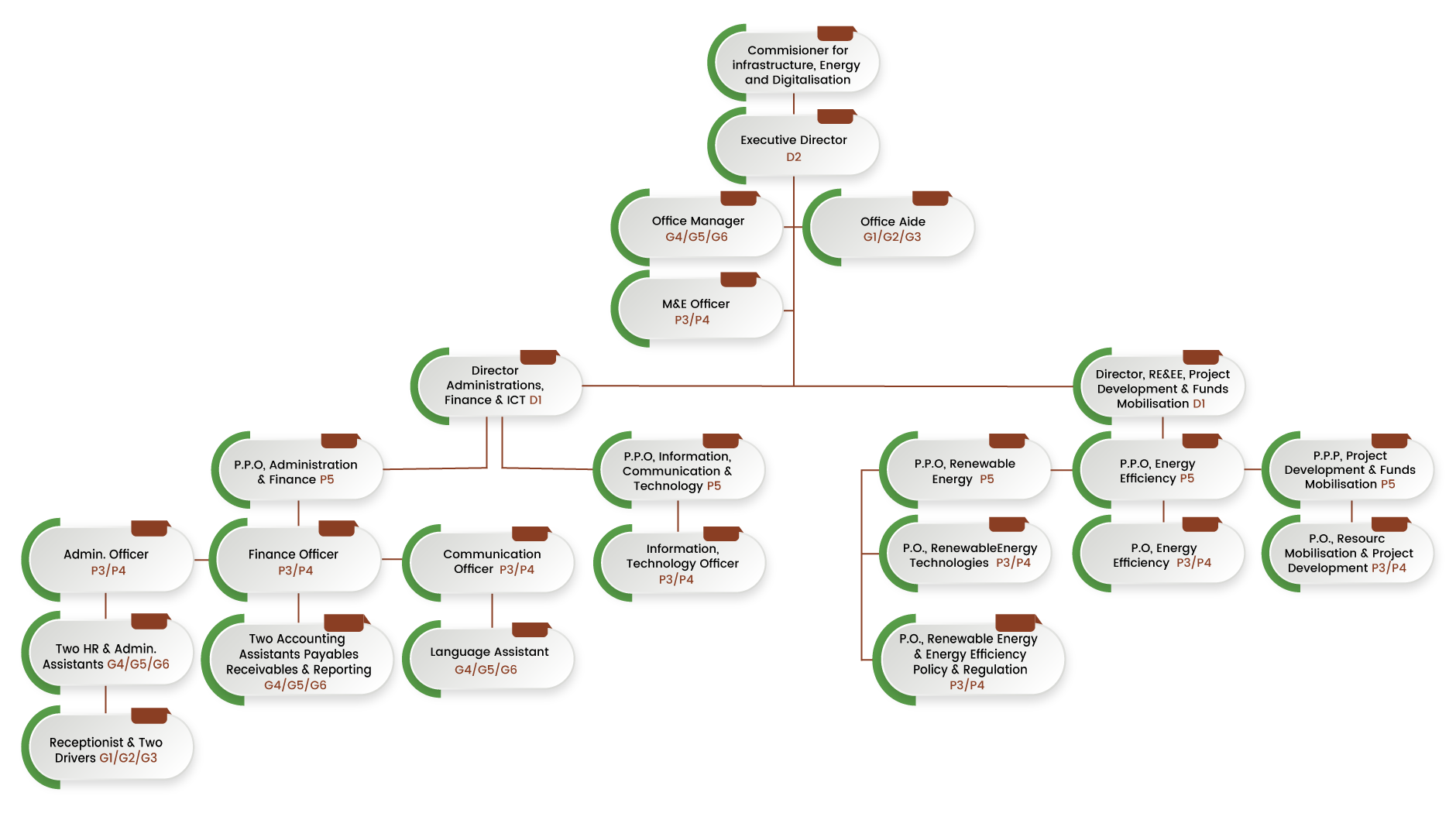
According to regulation PC/REX.5/06/2020 on the Organization and Functioning of ECREEE, the daily operations are overseen by the Executive Director, who directly reports to the Hon. Commissioner for Energy, Infrastructure, and Digitalization (EID) at the ECOWAS Commission. The Executive Director is further supported by two Directorates: Administration Finance and ICT, and RE&EE Project Development & Resource Mobilization, as illustrated in the organizational chart below.
ECREEE’s Organization Chart:

Comments are closed, but trackbacks and pingbacks are open.