
When Water Becomes a Source of Energy
Hydropower is one of the oldest renewable energy sources used in Africa. Major rivers such as the Congo, the Nile, the Niger and the Zambezi offer enormous potential that remains largely underexploited. But how does a dam actually transform the power of water into electricity used in African homes, industries and cities?
A deep dive into a strategic piece of infrastructure.
What Is a Hydroelectric Dam?
A hydroelectric dam is an infrastructure built across a river in order to:
- retain water,
- create a reservoir,
- use the force of falling or flowing water to generate electricity.
Unlike thermal power plants, it does not burn any fuel: the energy comes solely from the movement of water.
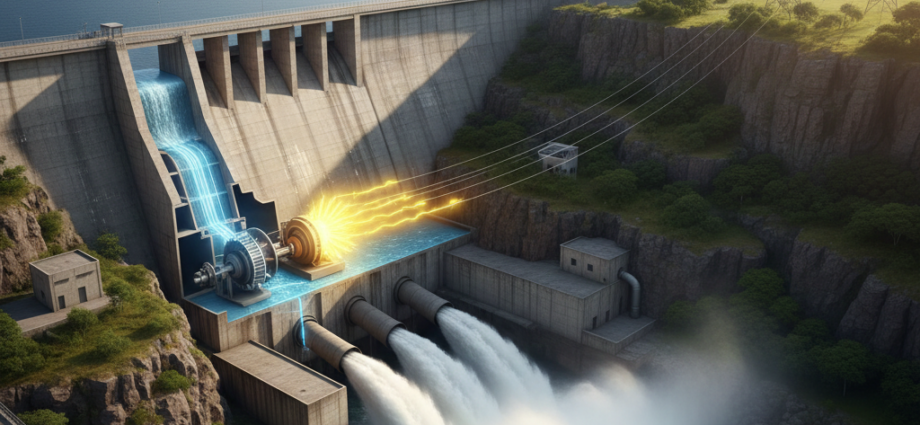
How Does a Dam Work, Step by Step?
1️⃣ Water Storage
The dam partially blocks the river, forming a reservoir. The higher the water level, the greater the potential energy.
2️⃣ Water Release
When electricity is needed, water is released and rushes through large penstocks at high speed.
3️⃣ The Turbine
The flowing water spins a turbine, the true mechanical heart of the power plant. Its rotation depends on the water flow and the height of the drop.
4️⃣ The Generator
The turbine drives a generator (alternator), which converts mechanical energy into electricity.
5️⃣ The Transformer
The electricity produced is then:
- converted into high voltage,
- injected into the power grid,
- transmitted to cities, industries and rural areas.
Why Hydropower Is Strategic for Africa
Key Advantages
- Renewable energy with low CO₂ emissions
- Low operating costs over the long term
- Stable baseload power generation
- Storage capacity through reservoirs
Key Challenges
- High upfront investment costs
- Environmental and social impacts
- Dependence on climatic conditions
- Population displacement in some projects
Hydropower in Africa: Selected Examples
- Inga Dam (DRC): one of the largest hydropower potentials in the world
- Manantali Dam (Mali): a backbone of the OMVS regional power system
- Grand Ethiopian Renaissance Dam (Ethiopia): a strategic project for East Africa
- Nachtigal Dam (Cameroon): strengthening national electricity generation
Hydropower and Africa’s Energy Future
In the context of the energy transition, hydropower remains a key pillar of Africa’s electricity mix. Combined with solar and wind energy, it helps to:
- stabilize power grids,
- reduce dependence on fossil fuels,
- improve access to electricity.
However, future development must integrate sustainability, dialogue with local communities and climate resilience.
Key Takeaway
A hydroelectric dam is more than just a concrete wall:
it is a complex system that transforms a natural resource into electricity, serving economic and social development across Africa.

Comments are closed, but trackbacks and pingbacks are open.